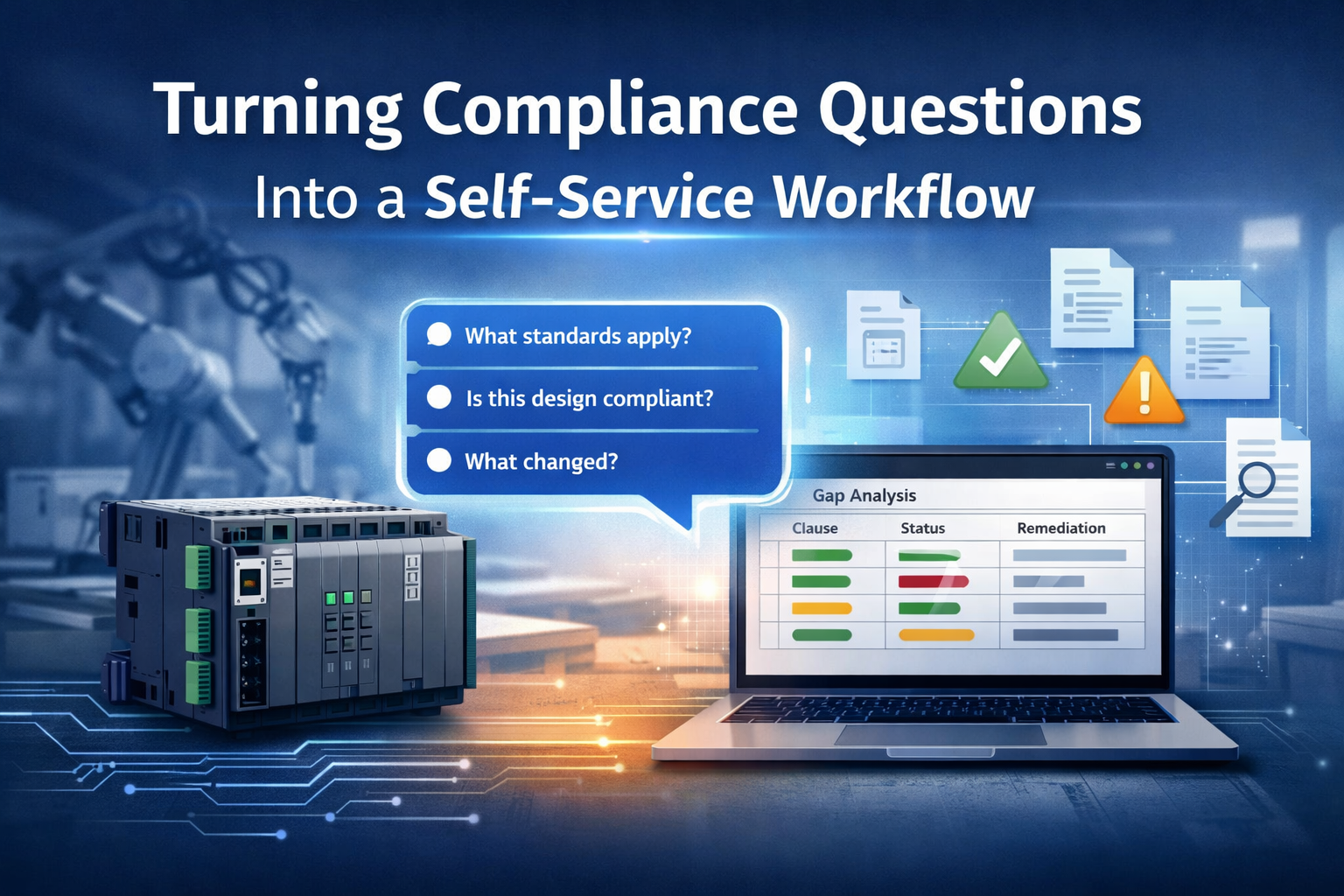

Compliance teams inside industrial automation companies face a familiar problem: they are not blocked by standards themselves—but by constant internal questions about them.
Engineers ask:
- “What standards apply to this controller?”
- “Does this design comply with clause X?”
- “What changes if we swap this component?”
Each question is reasonable. Collectively, they overwhelm teams already stretched thin.
This post walks through how one industrial organization used an AI-assisted compliance workflow to turn those questions into a self-service system, without losing traceability or audit readiness.
The Starting Point: A Representative Internal Product
Rather than starting with a full certification program, the team began with a single internal reference project: a configurable industrial automation controller used inside automated machinery.
The product included:
- Electronics and firmware
- Safety-relevant inputs and outputs
- A metal enclosure intended for panel mounting
- Partial documentation (by design)
The goal was not to certify the product—but to answer a simpler question:
“Can we centralize and automate how people ask and answer compliance questions?”
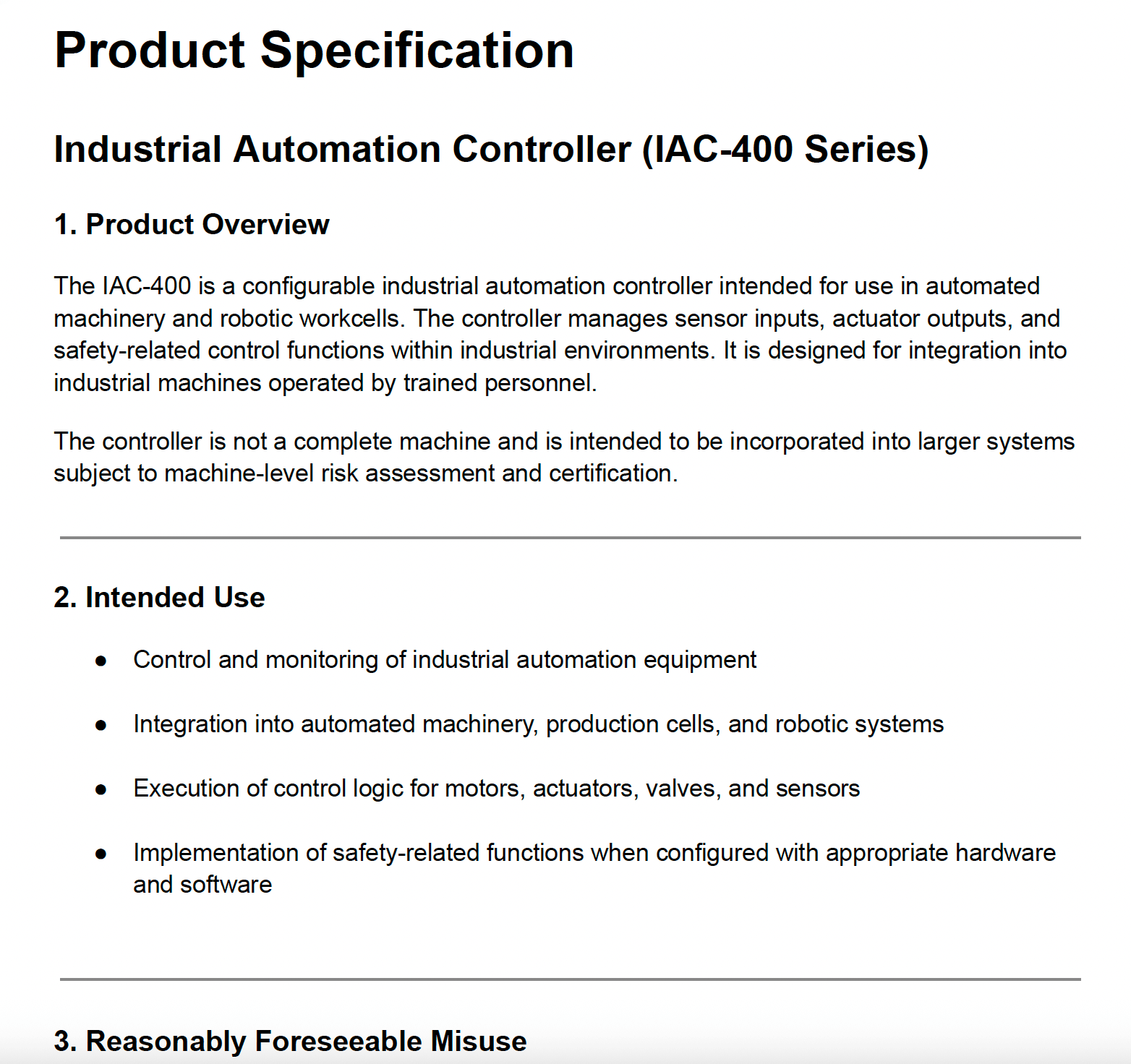
[Screenshot: Product specification input used for standards selection]
Step 1: Automatically Identifying Applicable Standards
The first workflow step was to input a concise product description—intended use, environment, electrical characteristics, and safety assumptions—into a standards selection tool.
Instead of manually reviewing dozens of documents, the system surfaced a targeted set of applicable standards, including:
- Machinery safety and risk assessment
- Electrical equipment of machines
- Safety-related control systems
- Regional conformity requirements
Each standard was linked to why it applied, not just that it applied.
This immediately eliminated one of the most common internal questions: “Do we even need to care about this standard?”
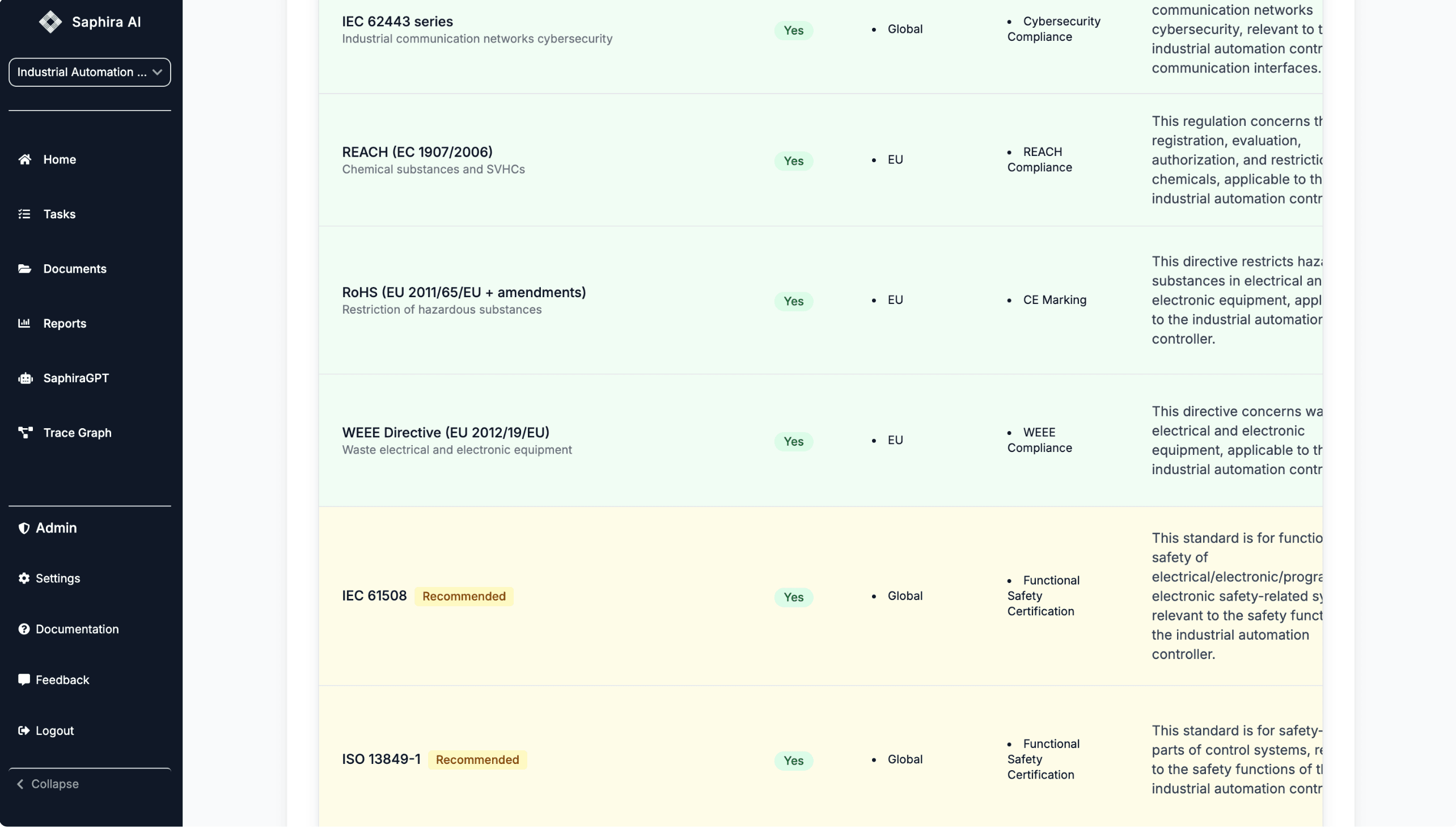
[Screenshot: Applicable standards list with justification]
Step 2: Mapping Internal Documents to Standard Clauses
Next, the team uploaded existing internal artifacts:
- Electrical schematics (partial)
- A controller datasheet
- A preliminary risk assessment
- A high-level firmware safety concept
- A controller-level BOM
- A basic functional test checklist
No attempt was made to “clean this up” beforehand. The intent was to reflect reality.
The system automatically mapped document content to individual clauses across the applicable standards, producing a live gap analysis.
Each clause was marked as:
- Compliant
- Non-compliant
- Missing evidence
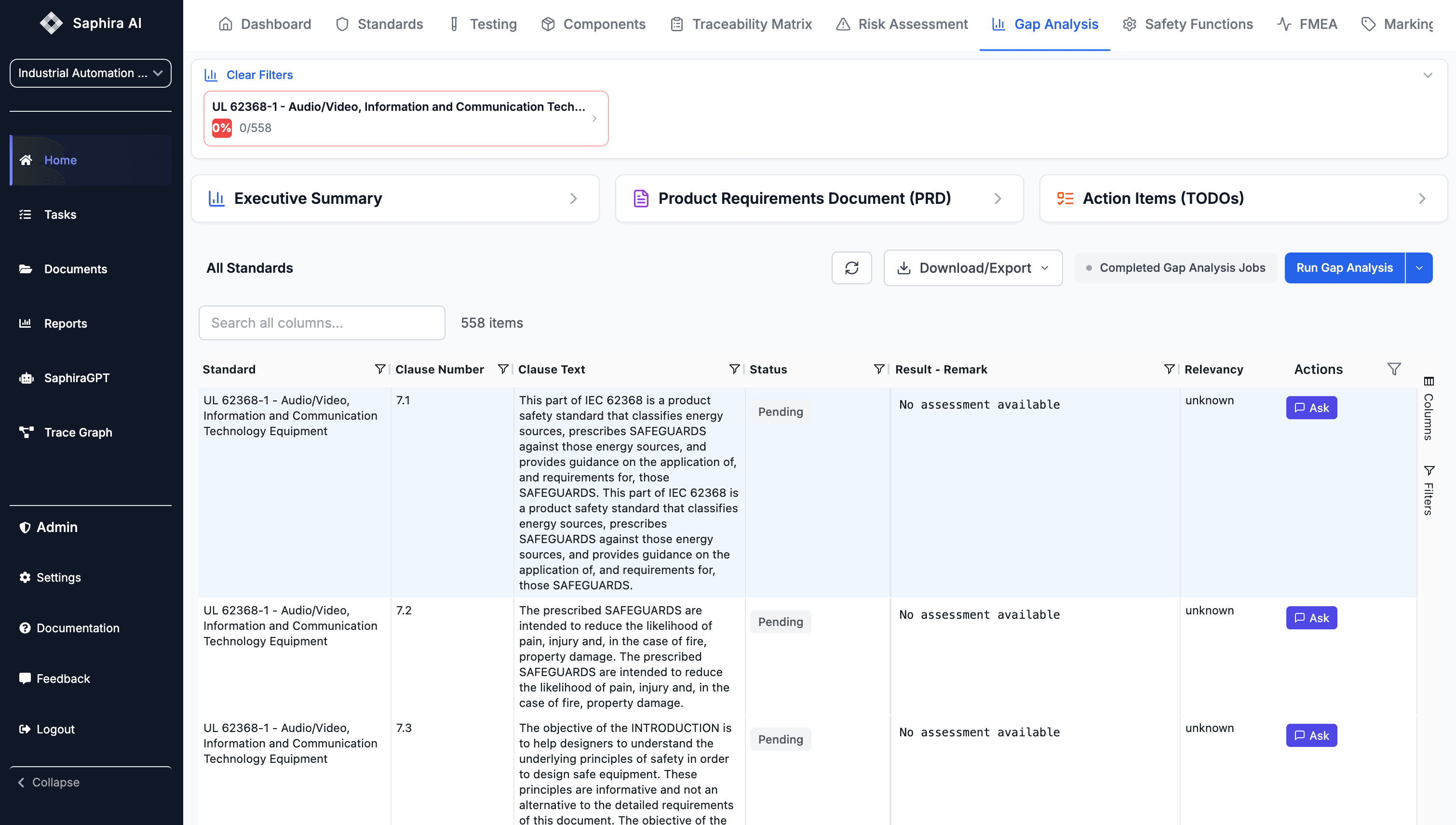
[Screenshot: Gap analysis table showing clause-level status]
Step 3: From “Is This Compliant?” to “What’s Missing?”
Instead of a binary answer, each non-compliant or incomplete clause included:
- The exact requirement text
- Linked internal evidence (if any)
- A concrete remediation description
- Pointers to what validation or testing was missing
This shifted conversations from opinion-based to evidence-based.
Engineers could now see:
- Why something didn’t comply
- What specifically needed to be added
- What was out of scope for the controller itself
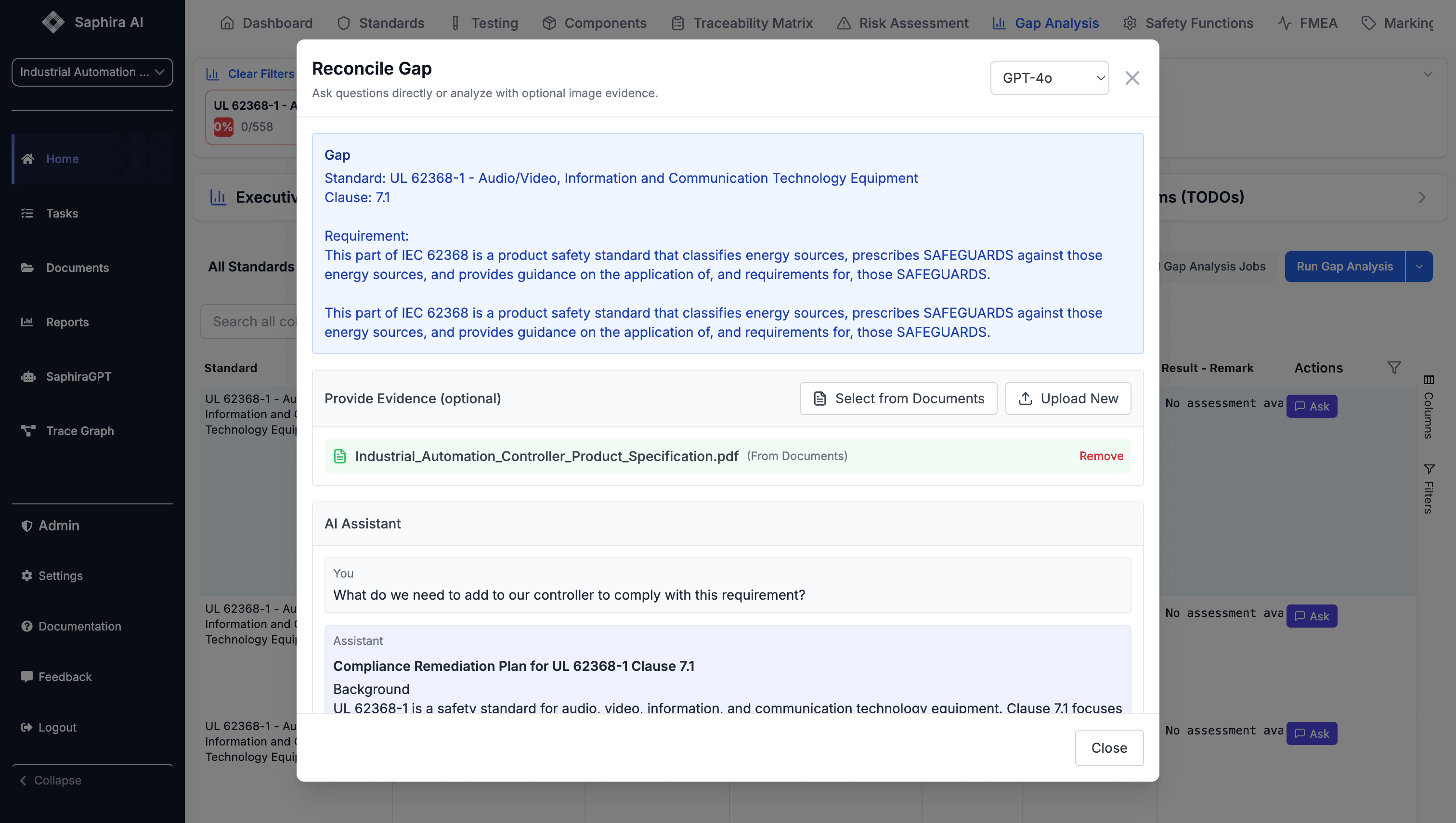
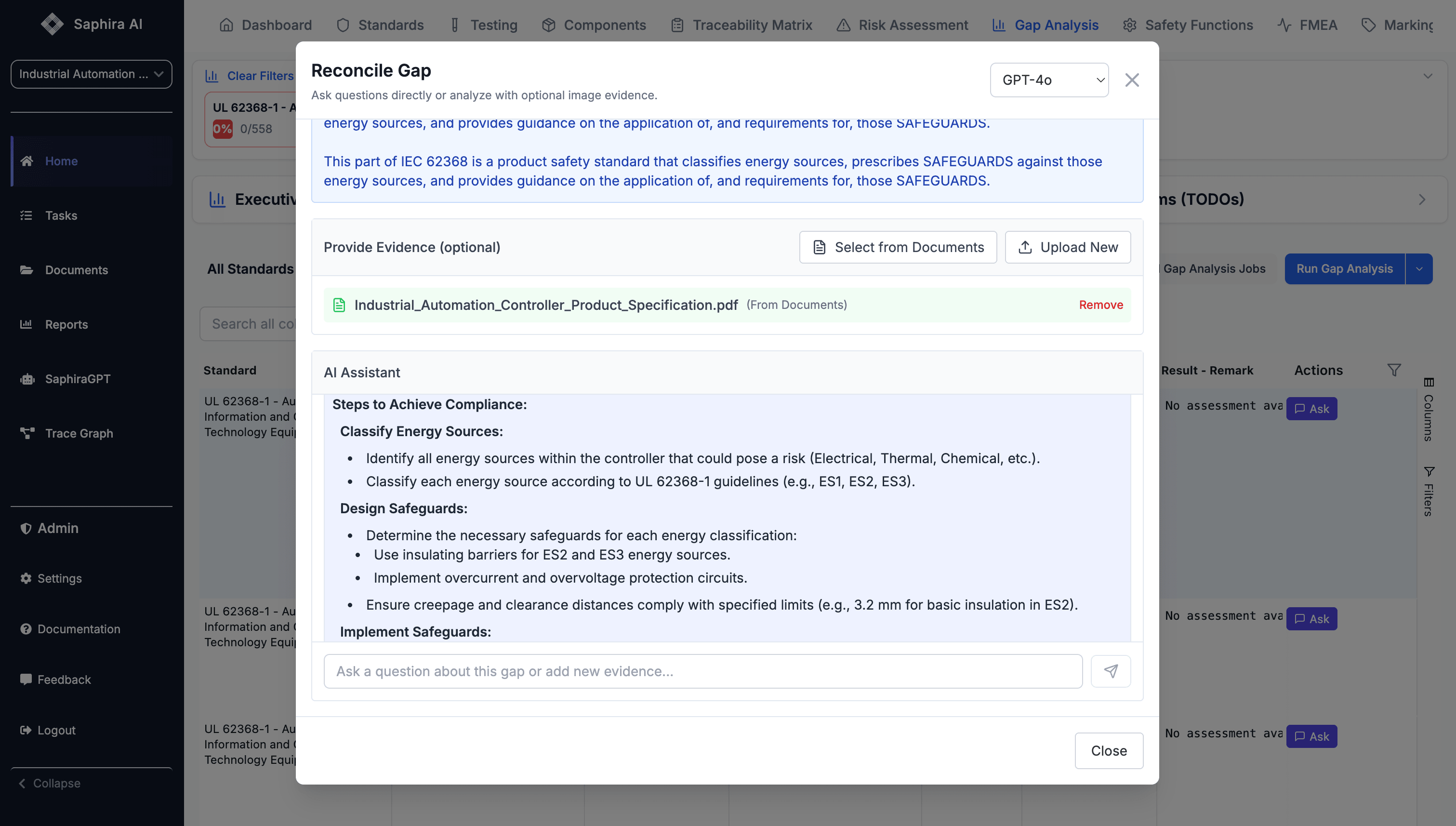
[Screenshot: Clause detail view with remediation guidance]
Step 4: Enabling a Self-Service Compliance Assistant
With standards structured and evidence mapped, the organization enabled a read-only internal compliance assistant.
Engineers could ask natural questions such as:
- “What standards apply to this controller?”
- “Does the E-Stop implementation meet safety requirements?”
- “What’s missing for compliance with safety control standards?”
Each answer was:
- Grounded in licensed standards text
- Linked back to specific clauses
- Connected to the organization’s own documentation
Crucially, answers never existed in isolation—they always pointed back to traceable evidence.
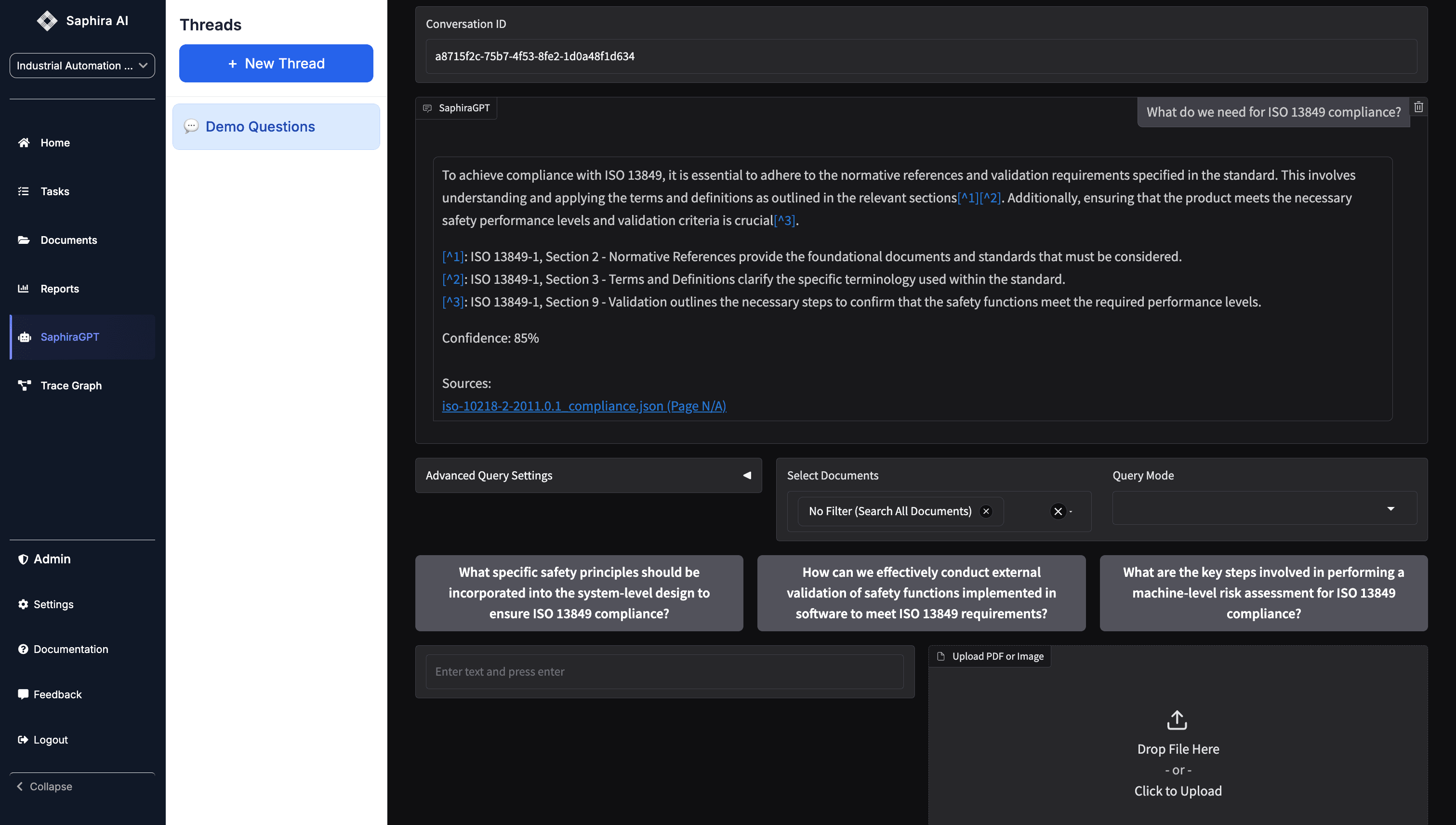
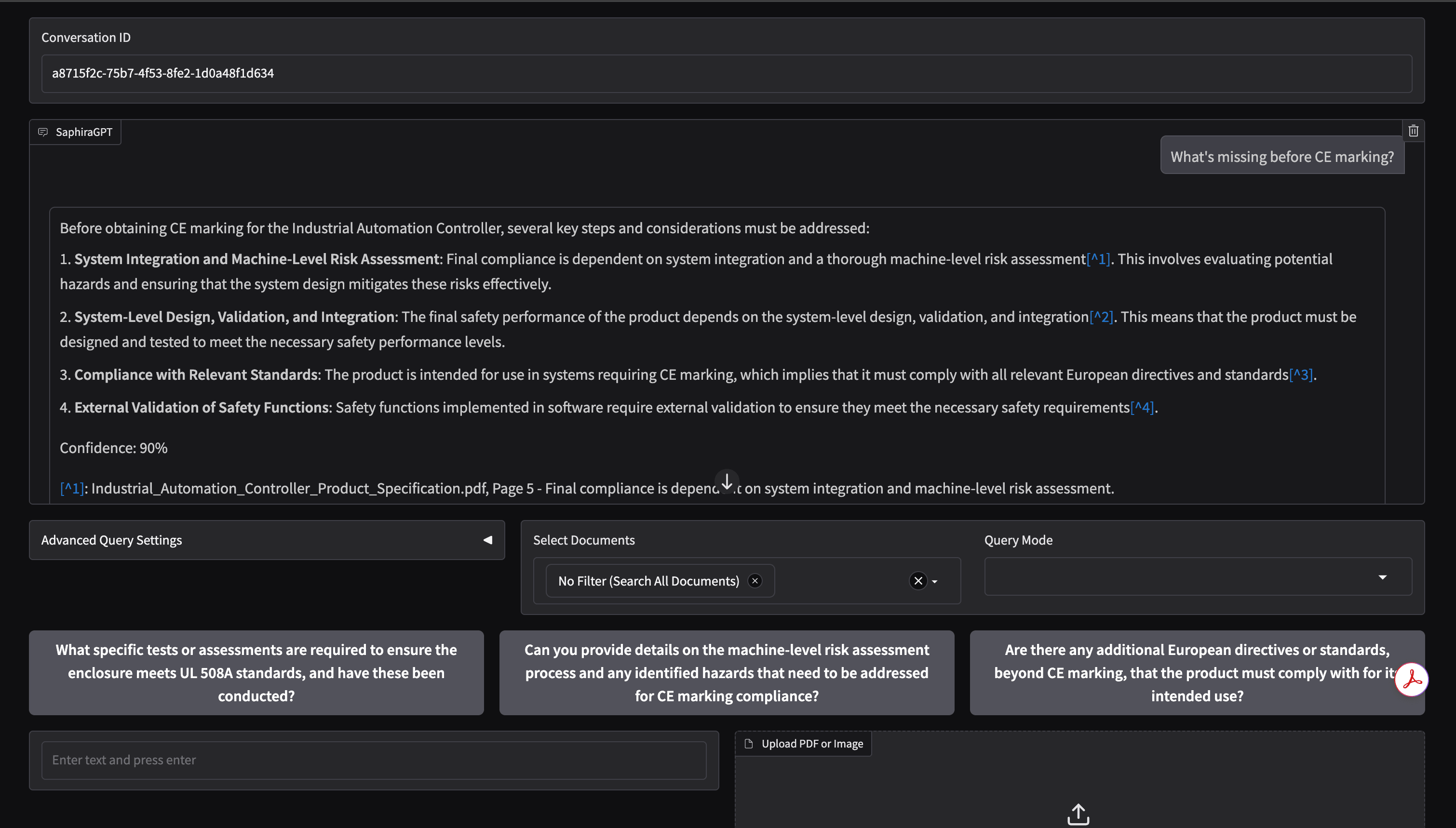
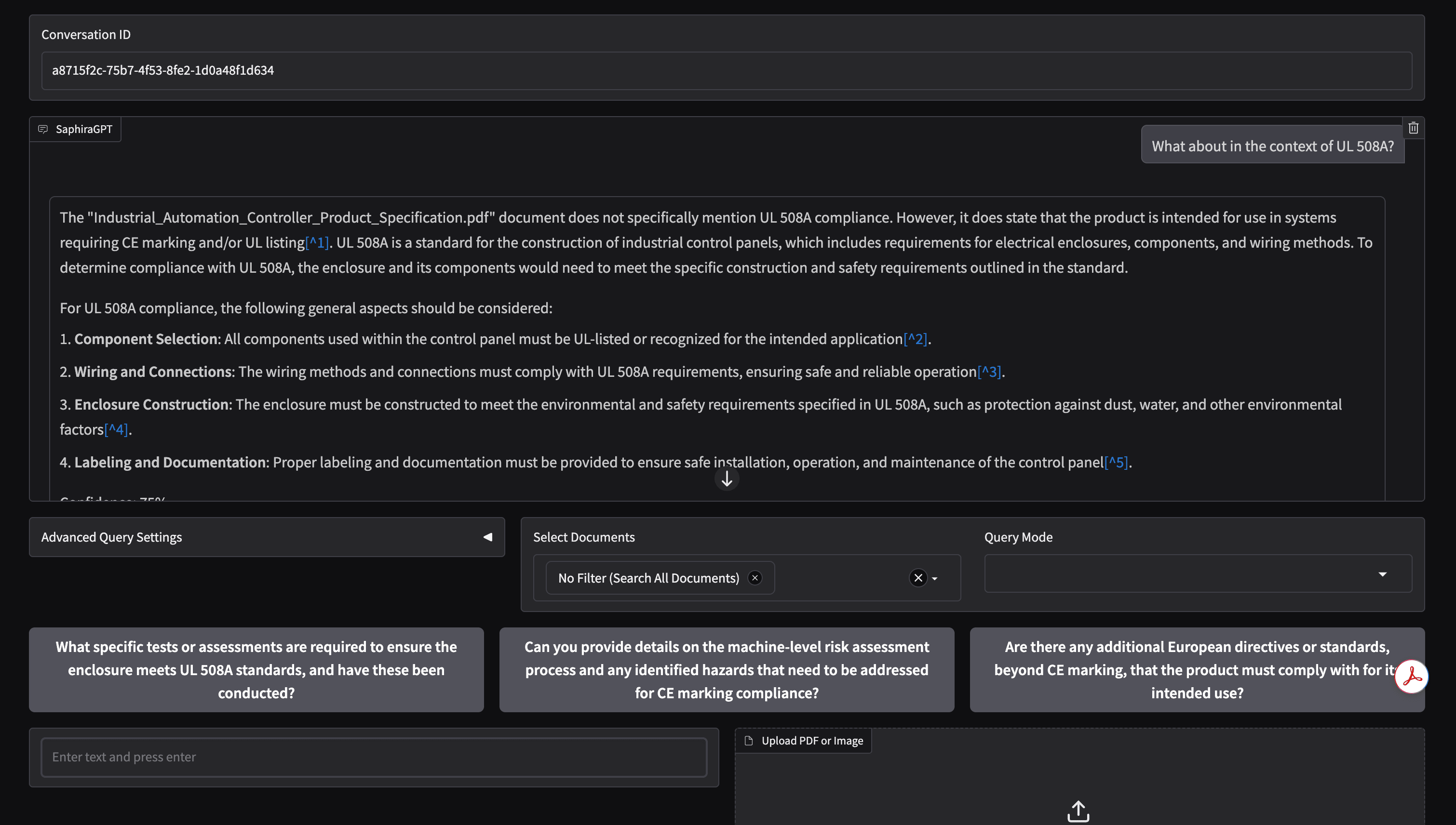
[Screenshot: Compliance chatbot answering a clause-specific question]
Step 5: Understanding Change Impact Before It Becomes a Problem
Finally, the team tested a common scenario: a component change.
When a power supply component was swapped in the BOM, the system automatically identified:
- Which clauses were affected
- Which tests needed re-validation
- Which documentation remained unchanged
This replaced broad uncertainty with a bounded impact report.
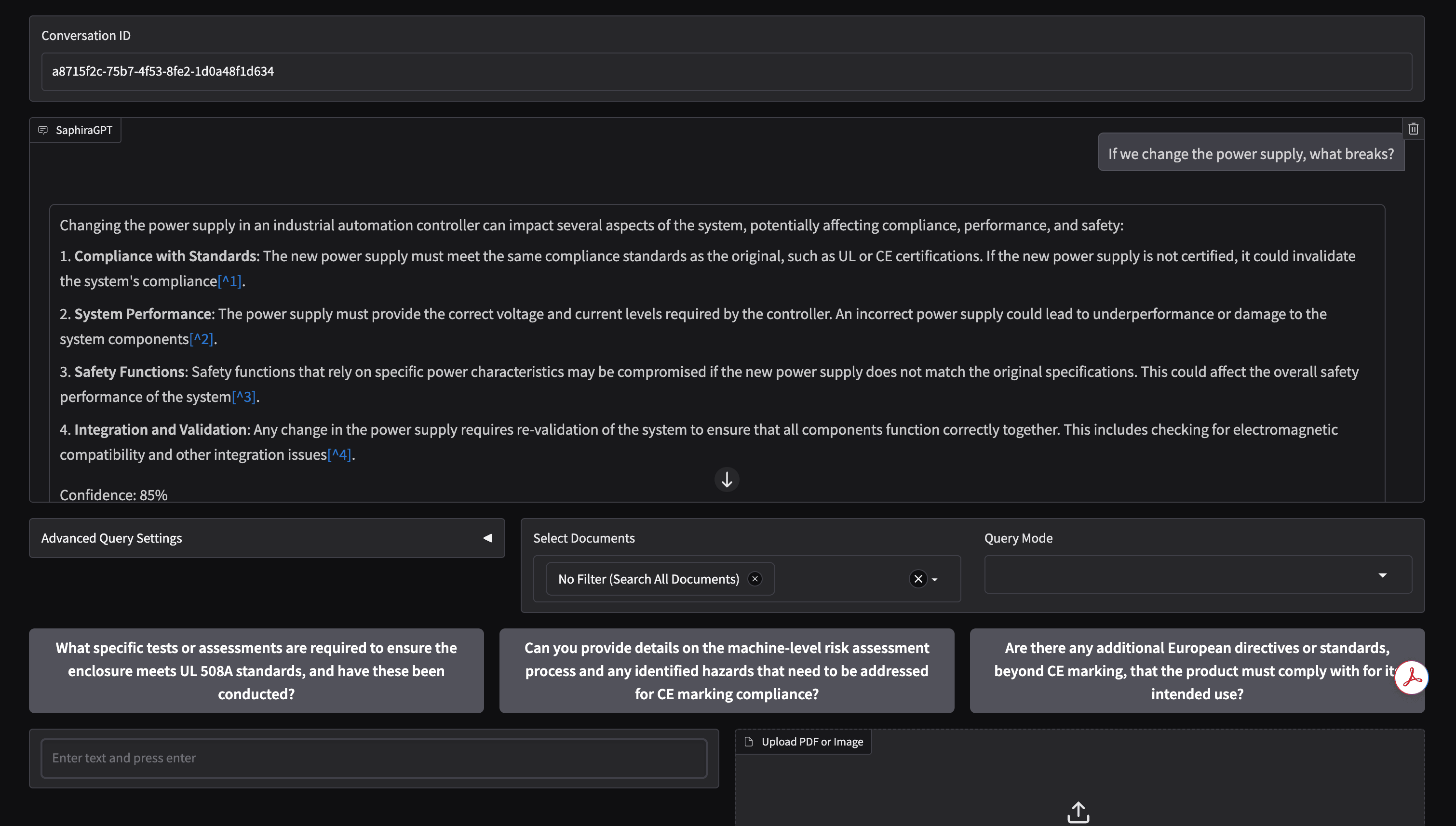
[Screenshot: Change impact analysis highlighting affected clauses]
The Outcome: Fewer Interrupts, More Confidence
The result was not “automated certification.”
Instead, the team achieved something more practical:
- Fewer ad-hoc compliance questions
- Faster, more consistent answers
- Better reuse of existing documentation
- Clear visibility into real compliance gaps
Compliance expertise stayed with the experts—but access to it scaled.
Why This Matters
As industrial systems grow more configurable and software-driven, compliance questions increase—not because teams are careless, but because systems are complex.
Treating compliance knowledge as a structured, queryable system—rather than a collection of PDFs and inboxes—changes how organizations work.
And it turns compliance from a bottleneck into shared infrastructure.
If your team is buried under internal compliance questions, start with a single reference product. You may not need to automate certification—you may just need to automate access to answers.