
The last generation of enterprise software created trillion-dollar businesses by becoming systems of record. Salesforce owned customer data. Workday owned employee data. SAP owned operational data. If you owned the canonical object, you owned the workflow—and the lock-in.
AI agents challenge that model. As the interface to work shifts from forms and dashboards to agents that reason and act across systems, the real question isn’t whether systems of record survive—but what kind of systems agents actually need underneath them.
At Saphira, we believe the next generation of compliance software won’t be defined by who stores the final document or checklist. It will be defined by who captures context: the reasoning, decisions, and tradeoffs that connect standards, risks, mitigations, and evidence over time.
That structure is what we call a context graph—and it’s why Saphira can replace incumbent safety and compliance platforms rather than merely integrate with them.
The Hidden Problem in Safety & Security Compliance
Traditional safety and security compliance tools—whether requirements management systems, QMS platforms, or ALM extensions—optimize for static artifacts:
- Requirements lists
- Risk assessment tables
- Test plans
- Audit-ready PDFs
Tools like Itemis, IQS, and similar platforms do a good job storing these outputs. But they fail at something far more important:
They don’t capture how decisions were made.
In real safety workflows, compliance is not a linear checklist. It’s a sequence of judgment calls:
- Why was this hazard rated S2 instead of S3?
- Why was a safeguard accepted as “sufficient” in this context?
- Why does this machine rely on procedural controls instead of design measures?
- Why was this cybersecurity threat mitigated operationally instead of technically?
Those answers rarely live in the system of record. They live in:
- Comments inside spreadsheets
- Side conversations with assessors
- Slack threads during audits
- Engineers’ heads
When designs change—or when a regulator asks “why”—teams are forced to reconstruct context that was never stored as data in the first place.
Why Agents Change the Equation
AI agents don’t just retrieve information. They act:
- They evaluate standards
- Propose mitigations
- Flag gaps
- Route approvals
- Generate evidence
But agents can’t reason reliably from static artifacts alone. They need access to decision traces:
- What rule applied
- What exception was taken
- What precedent existed
- Who approved the outcome
- Under which standard revision and system configuration
Without that, agents hallucinate—or worse, automate the wrong behavior.
This is where most incumbent platforms break down. They were designed to store outcomes, not capture reasoning at execution time.
What Saphira Does Differently
Saphira sits in the execution path of safety and security workflows.
Every time a team:
- Interprets a standard clause
- Identifies a hazard or threat
- Assigns risk severity or likelihood
- Selects a mitigation
- Accepts residual risk
- Responds to a design change
Saphira captures not just what happened—but why.
Each action emits a decision trace:
- Inputs used (standards, system metadata, prior assessments)
- Rules evaluated (ISO 12100 hierarchy, IEC 61508 SIL logic, ISO 21434 threat categories)
- Exceptions or assumptions applied
- Approvals or overrides
- Resulting state change
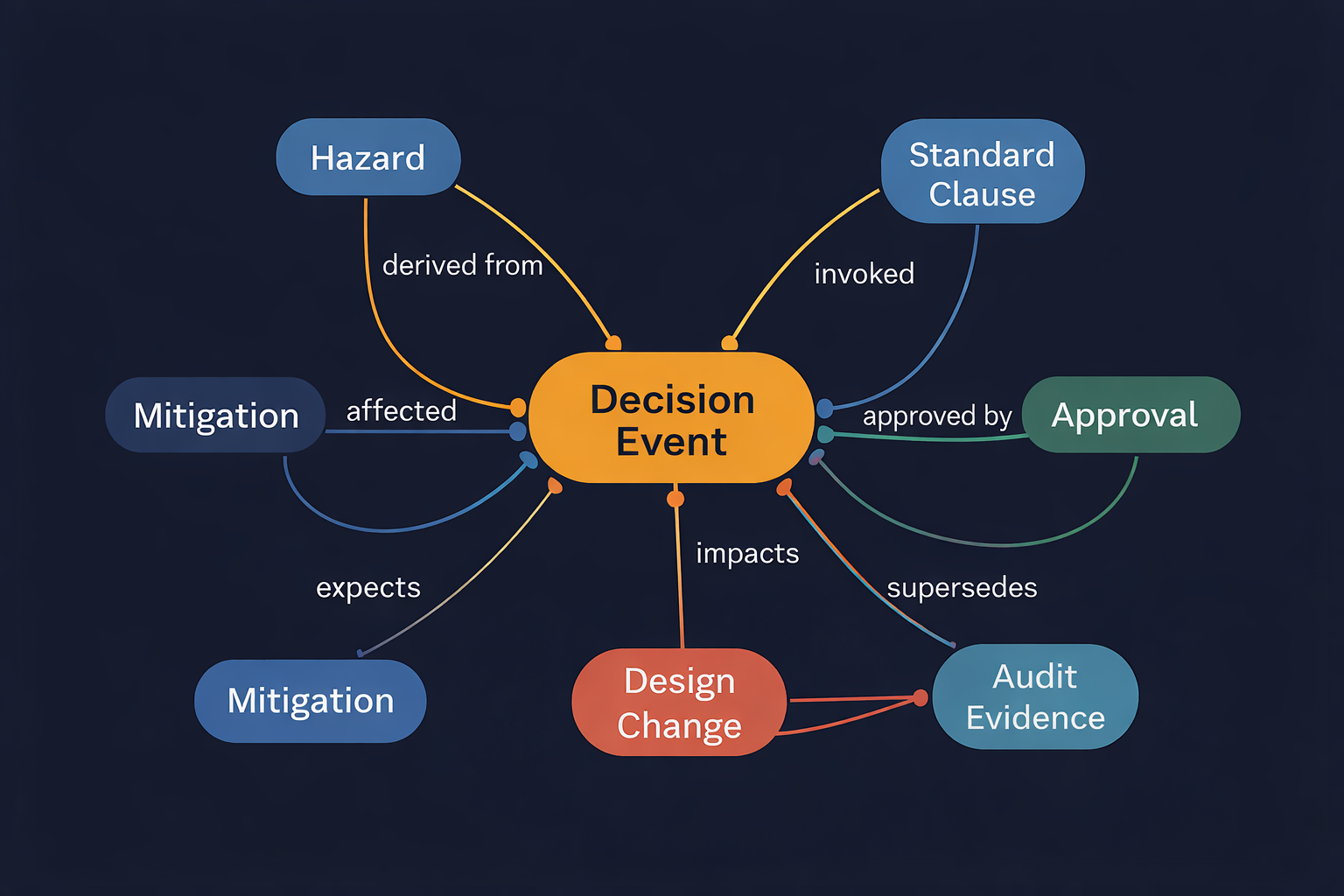
Over time, these traces form a context graph.
What Is a Context Graph in Safety & Compliance?
A Saphira context graph connects the entities safety teams already care about:
- Standards & clauses
- System functions and components
- Hazards, risks, and threats
- Mitigations and safety requirements
- Tests, analyses, and evidence
- Design changes and revisions
- Approvals and rationale
But instead of linking them statically, the graph is built around decision events—the moments where judgment was exercised.
That means Saphira doesn’t just answer:
“Is this requirement satisfied?”
It answers:
“Why was this requirement interpreted this way, under this system configuration, given these hazards, and based on which precedent?”
That distinction is everything.
Why This Replaces Incumbents Like Itemis and IQS
Incumbent tools were built for document-centric compliance:
- Manage requirement objects
- Track completion states
- Export reports for audits
They assume:
- The reasoning happened elsewhere
- The human remembers why
- The document is the source of truth
Saphira inverts that model.
In Saphira:
- The decision trace is the source of truth
- Documents are generated views of the graph
- Traceability is native, not retrofitted
- Change impact is automatic, not manual
When a machine design changes, Saphira doesn’t ask:
“Which documents might be affected?”
It knows:
- Which hazards were introduced
- Which assumptions no longer hold
- Which mitigations depended on the old design
- Which standards clauses must be re-evaluated
That’s not possible in systems that only store end-state artifacts.
Compounding Value Over Time
The real power of context graphs is that they compound.
Each completed assessment:
- Becomes precedent
- Improves future interpretations
- Reduces repeated debates
- Enables higher-confidence automation
Over time, Saphira becomes:
- The memory of how your organization applies standards
- The explanation layer regulators actually want
- The substrate agents can safely reason over
This is why customers don’t just use Saphira alongside incumbent tools—they replace them.
Once the context graph exists, maintaining a parallel system of record adds no value.
Systems of Record, Reimagined for Safety
The future of safety and security compliance isn’t about storing more documents. It’s about capturing why decisions were allowed to happen.
Agents make that unavoidable. Regulators make it valuable. Complex systems make it necessary.
Saphira isn’t just automating compliance. It’s creating the system of record for safety decisions themselves.
That’s what context graphs unlock—and why this category looks nothing like the last one.