
From Requirements to Risk Closure: A Modern, Requirements-Driven FMEA Workflow
Why FMEA Execution Still Slows Teams Down
Failure Mode and Effects Analysis (FMEA) is a mature, well-understood discipline. Most systems and safety engineers don’t struggle with the methodology — they struggle with execution.
In real programs, FMEA is slowed by structural friction rather than lack of expertise. Requirements are scattered across PDFs, Word documents, and legacy artifacts, forcing teams to manually re-enter and reconcile data before analysis can even begin. Failure modes are often brainstormed in isolation from functional requirements, making rationale and coverage difficult to defend later. Risk scoring and updates rely on spreadsheets that are hard to keep consistent, and traceability to verification and standards is typically maintained outside the FMEA itself.
The result is an FMEA that exists, but is expensive to create, difficult to maintain, and disconnected from the rest of the engineering lifecycle — especially as designs evolve.
This is the gap a requirements-driven, AI-assisted FMEA workflow is designed to close.
A Workflow Built Around How Engineers Actually Work
Rather than treating FMEA as a standalone activity, our platform treats it as a derivative artifact — generated directly from requirements and kept continuously in sync with design intent, verification planning, and compliance tracking.
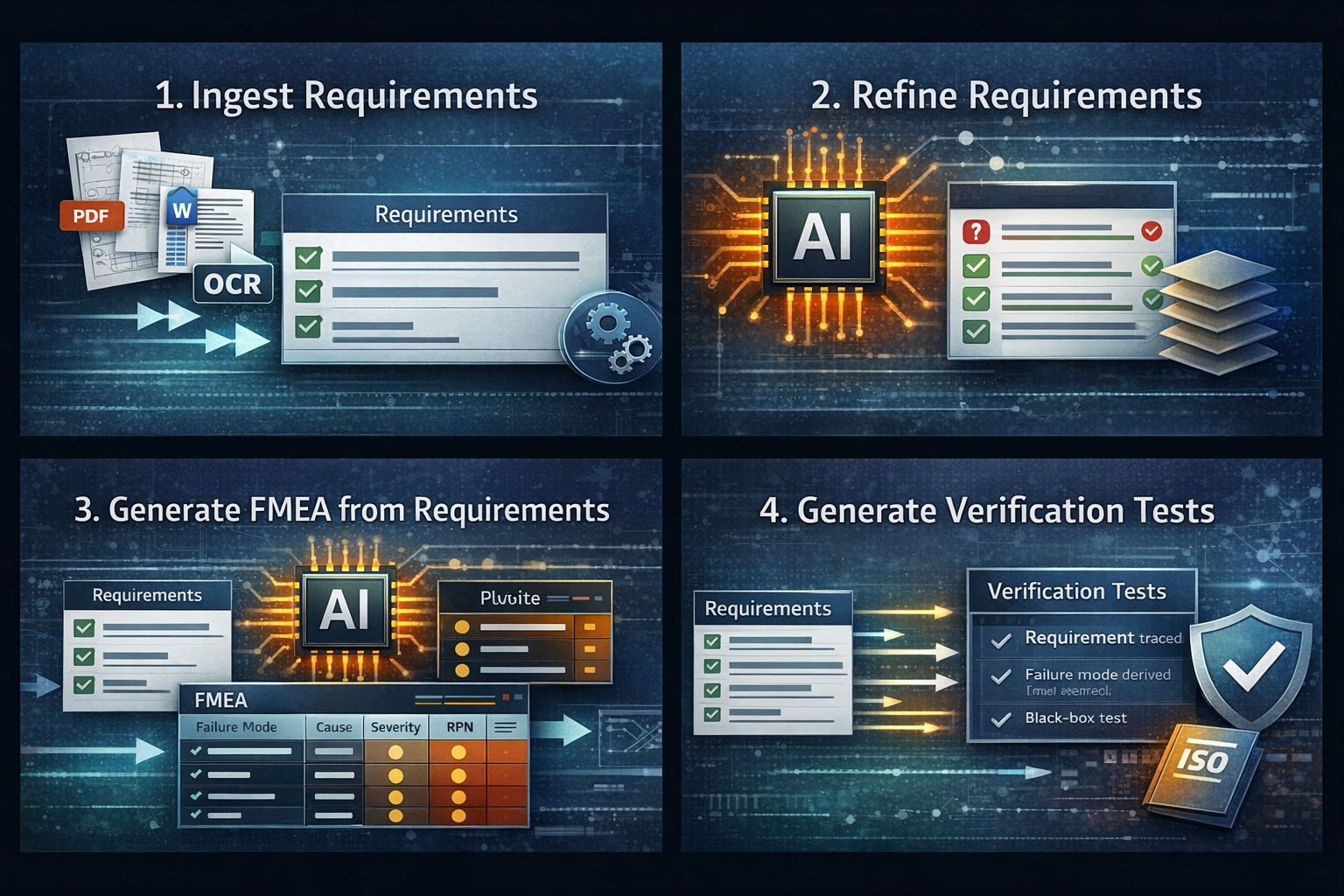
At a high level, the workflow follows five steps:
- Ingest and structure requirements
- Refine and validate requirement intent
- Generate FMEA from functional requirements
- Generate and link verification tests
- Maintain end-to-end traceability, including standards
Each step removes a specific source of friction in traditional FMEA execution.
Step 1: Ingest Requirements Without Manual Re-Entry
Most FMEAs begin with a non-trivial amount of manual work: copying requirements from documents into spreadsheets or FMEA tools. This step is time-consuming, error-prone, and immediately breaks traceability to the source material.
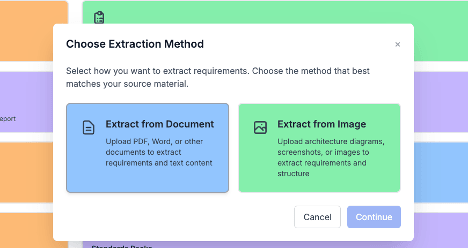
Our workflow starts by ingesting existing artifacts directly:
- PDF and Word specifications
- Legacy documents
- Images and screenshots (via OCR)
Extracted requirements remain linked to their source documents, preserving context and making review easier. Engineers can quickly verify what was extracted, correct errors, and move forward without rebuilding a baseline from scratch.
Step 2: Refine Requirements Before Analyzing Risk
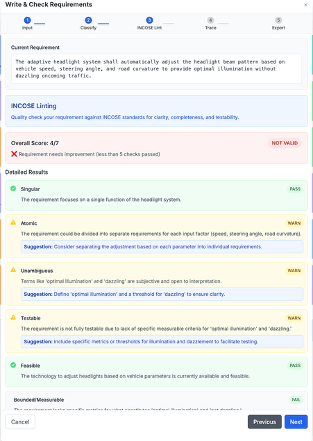
Poorly written or ambiguous requirements create downstream noise in FMEA. Instead of forcing engineers to clean this up manually, the platform provides AI-assisted refinement focused on:
- Clarity and testability
- Ambiguity reduction
- Logical consistency
- Hierarchical organization (system → subsystem → HW/SW where applicable)
Importantly, refinement is reviewable and versioned. Engineers remain in control of wording and intent, but spend less time rewriting and more time validating.
This step ensures that the FMEA is generated from clear functional intent, not vague or inconsistent inputs.
Step 3: Generate FMEA Directly from Functional Requirements
Traditional FMEA creation often relies on workshops and expert memory. While valuable, this approach makes it difficult to demonstrate why a failure mode exists or whether coverage is complete.
In this workflow, failure modes are generated directly from functional requirements:
- System functions are identified implicitly from requirement intent
- Failure modes are derived by analyzing how those functions could fail
- Each failure mode includes explicit rationale tied back to requirements and assumptions
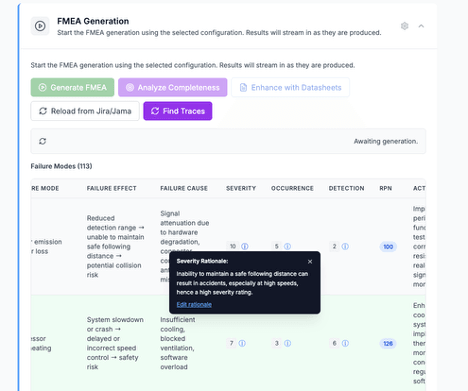
The result is a component-level, function-driven FMEA aligned with AIAG/VDA structure:
- Failure mode
- Cause
- Effect
- Severity, Occurrence, Detection
- Mitigation proposals
Because each failure mode is requirement-derived, traceability is inherent rather than retrofitted.
Risk scoring follows standard Severity / Occurrence / Detection conventions and supports RPN-based prioritization, while still flagging high-severity issues independently for review.
Step 4: Generate Verification Intent from Failure Modes
One of the most common gaps in FMEA execution is the weak link between risk analysis and verification.
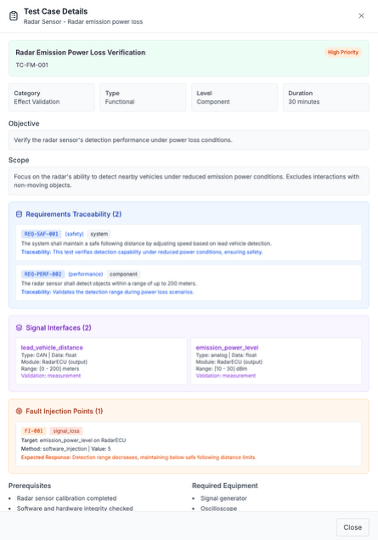
In this workflow, failure modes become the primary source of verification intent:
- High-level, black-box test cases are generated for each failure mode
- Tests are explicitly linked: Requirement → Failure Mode → Test Case
- Engineers can edit, remove, or add tests without breaking traceability
This approach makes verification intent explicit and defensible, rather than implied or distributed across separate documents.
The goal is not executable test scripts, but clarity of coverage: every significant failure mode has a corresponding verification strategy.
Step 5: Maintain End-to-End Traceability and Standards Context
As systems scale, traceability becomes less about compliance and more about engineering efficiency. When requirements change, teams need to understand impact immediately.
The platform maintains a continuous digital thread across:
- Source documents → requirements
- Requirements → failure modes
- Failure modes → tests
- Artifacts → standards clauses
Engineers and reviewers can traverse this graph in either direction, quickly identifying:
- Missing coverage
- Orphaned tests
- Failure modes without clear rationale
Where applicable, standards such as ISO 13849, IEC 61508, ISO 12100, and UL 4600 can be navigated at the clause level and linked to relevant requirements, FMEA entries, and evidence.
This makes audits and safety reviews navigational rather than forensic.
Why This Matters
This workflow does not attempt to replace engineering judgment. Instead, it removes the mechanical overhead that slows teams down:
- Less manual re-entry
- Fewer disconnected artifacts
- Clearer rationale for failure modes
- Stronger linkage between risk and verification
- Traceability that survives change
For systems engineers and safety teams, this means FMEA becomes:
- Faster to create
- Easier to review
- Easier to maintain
- Easier to defend
And for program leadership, it means clearer visibility into risk posture without relying on fragile spreadsheets.
Closing the Loop
Modern systems demand more than static FMEA tables. They require risk analysis that evolves with requirements, design decisions, and verification evidence.
By grounding FMEA generation in functional requirements and maintaining traceability through tests and standards, this workflow turns FMEA into a living engineering artifact — not a one-time deliverable.
If you’re interested in seeing how this approach works on real programs, we’d be happy to walk through it.