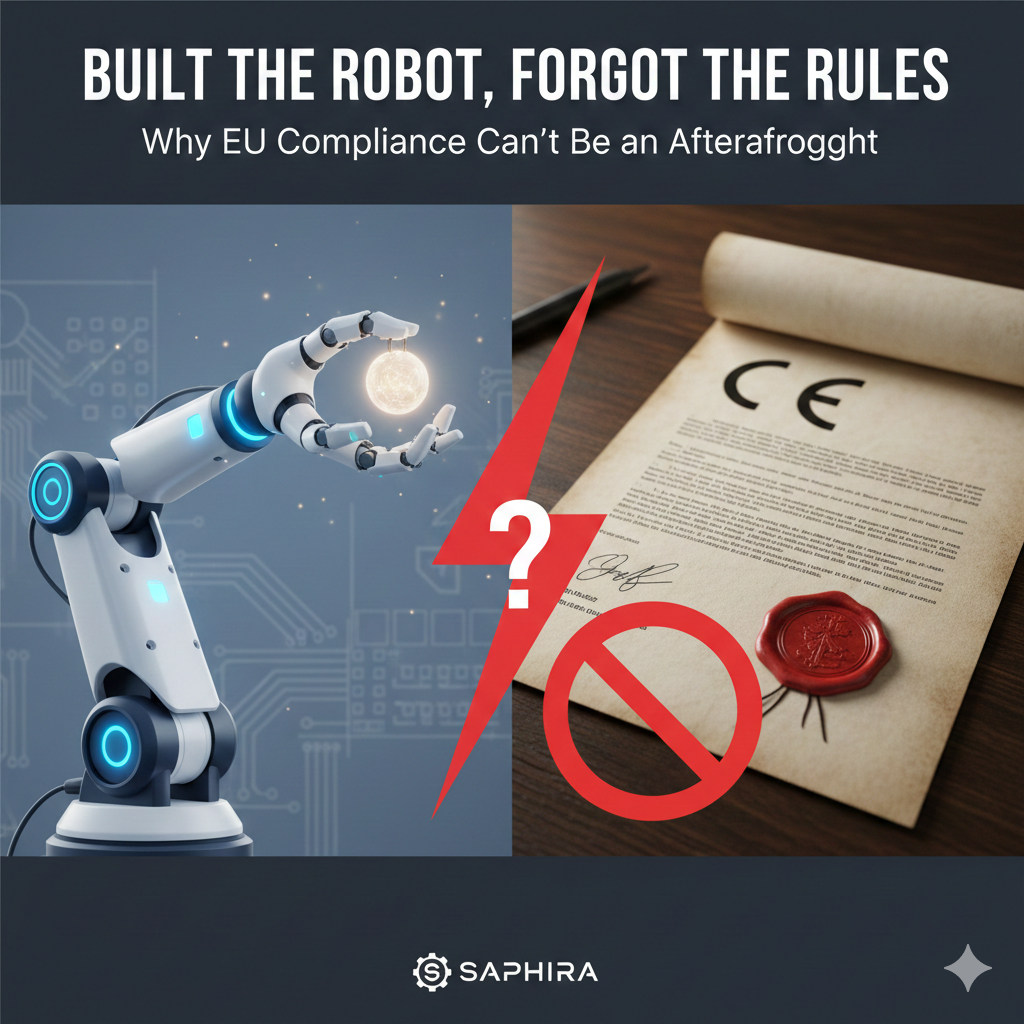

You built a robot, you spent a few months/years building it, you got your first client, but to your surprise, now you can’t sell it** **in the EU because you didn’t read the standards and requirements set by EU Directives. Now, you have to go back to the whiteboard, change the design, meet the requirements, test and then finally earn the ability to sell. You will end up spending months redesigning, extra engineering hours cost, extra BoM cost, and probably lost sales.
The European Union is infamous for coming up with regulatory requirements for new technologies. We at Saphira saw this first hand while working with a bunch of manufacturers working on state of art technology in the robotics space. However, these requirements are not there to make the manufacturer's life tough, but to keep the users safe. Osha’s accident search tool is a big eye opener on how much these regulations matter.
In this article I would focus on what are the minimum steps a manufacturer should take to not come across surprise sales restrictions, and I will keep this short.
You need to ask yourself, can my product create a hazard to the user. Will I let my mom, or kid use this product ? What if the robot crushes hand, what if a household product causes a spark and burn down a house with pets inside. Second, you need to understand that for each type of machine, there is a “set of rules” also called ‘standards’ which are drafted by industry experts. Second, you need to know which standards are applicable to your product in a region you are trying to sell. The U.S might have different standards, while the EU might have different standards. Once you know these you read the standards one by one, clause by clause, and meet the requirement by either assessment or testing. You then prepare a technical file and keep it as a record. In case of an accident, OSHA or insurance provider will ask you for these documents.
Basic protection and standards you need are:
ISO 12100- Risk Assessment: Most of the industries are moving towards hazard based compliance. This means you first figure out which hazards your product can create, and then assess your product to the only clauses which are relevant to this Risk Assessment.
Electrical Safety: This is basic protection against electrical, shock, fire and temperature hazards. There are multiple standards for multiple types of products. Some common ones are IEC 62368-1, IEC 61010-1, UL 3100, IEC 60204-1.
Functional Safety: This is to make sure that your product’s functions are safe. Think of Emergency Stop buttons, collaborative robot arms function, etc. You must make sure that your general operation will not crush, cut, or pin a person.
EMC: If you have an electrical product, you need to make sure that your product doesn’t interfere with other electrical products. These interference can occur from the outlet your product is plugged into, or through radiation.
Battery Safety: This is self explanatory and you must have seen fires emerging from EVs due to thermal runaway.
REACH/ RoHS/ PFAS: These regulations define requirements for toxic substances in your product which could be released to the environment during and after product lifespan.
There are some more like Radio, AI, Hazardous locations, Medical and Automotive. These industries can have multiple requirements and standards so one should look into these in depth.
Some Tips from Saphira:
- Consider safety during the initial planning phase. Don’t leave it for later. This will bite you back.
- Define your use case and operational environment - Are you going to use it indoors or outdoors, around people or away from people.
- Use certified components like batteries, wires, microcontrollers, etc. with UL or other marking
- Document Everything
Bonus Tip: Don’t assume CE marking is accepted in the U.S or other regions. It is only accepted in EU countries.
Compliance can be confusing and challenging, from finding the right standards, to meeting each and every requirement and finding which clauses can be waived. It is a continuous process and takes months using manual processes like reading PDF standards and creating checklist one by one in excel.
At Saphira we are automating this exact process. Happy to chat.